


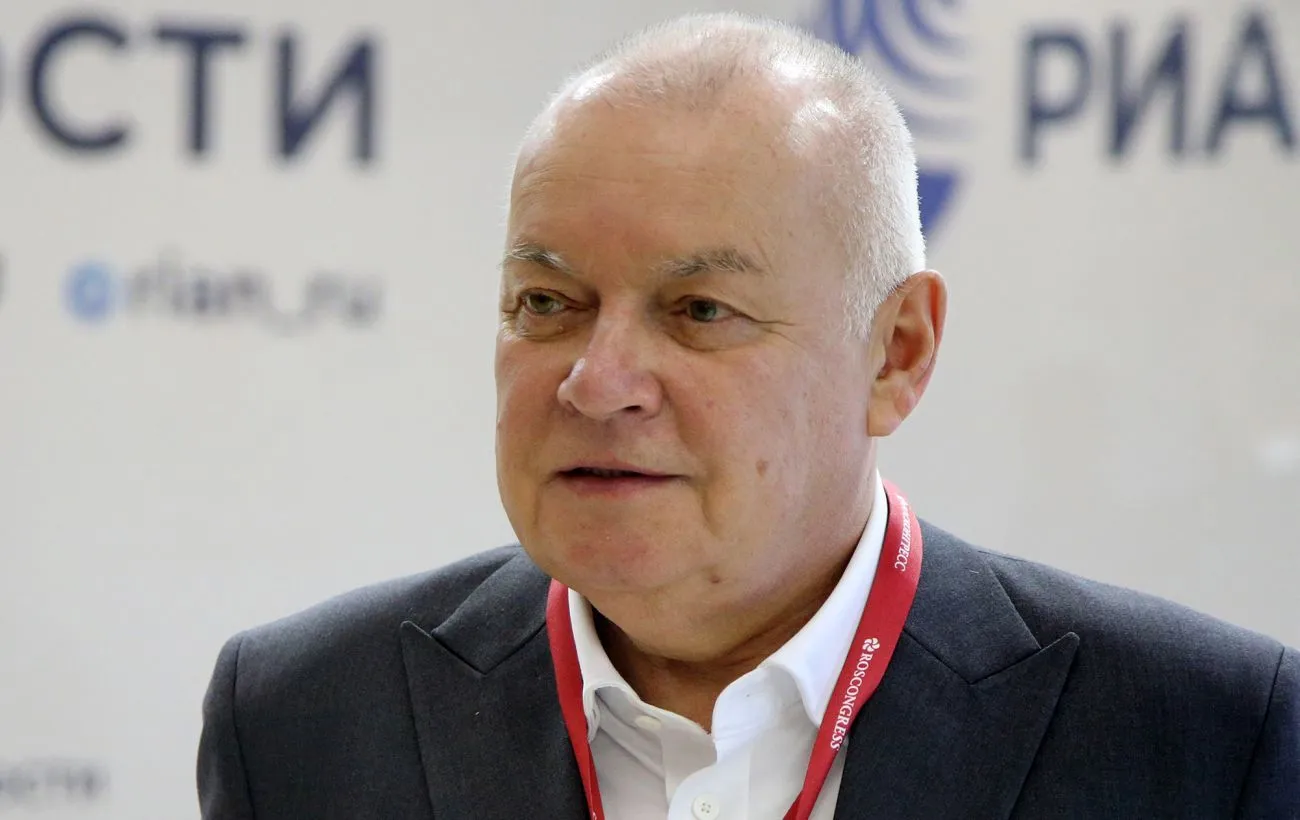
Now Vesti Nedeli will be hosted by Yevgeny Popov.
Kiselyov has been given a separate program at 10 p.m., which is simply called Kiselyov. But he has lost the main Sunday evening slot.
The program he had hosted since 2012 has been handed by VGTRK to a man twenty years younger.
Dmitry is still one of the country’s most popular political presenters. Why replace someone who is still capable of doing his job? And there is only one explanation.
Too Much War
State television over the past four years was created for a very specific kind of world. One in which compromise is weakness. Where negotiations are suspicious, the West is hostile to Russia, and Europe has betrayed itself.
For such a world, Kiselyov—or another presenter of the same type, Vladimir Solovyov—was ideal.
Francis Scarr, who observed Russian television for BBC Monitoring for many years, called political talk shows an important force in the country, and the presenters part of “a powerful media machine.”
And this machine was definitely not built for subtle turns.
Solovyov, too, was a useful element of mobilization-oriented television. He was always capable of raising the temperature by another few degrees.
But for television of a future détente, that is already a liability.
A man who spent four years explaining to viewers that the conflict with the West was almost existential is not suitable at a moment when it is already obvious to everyone that relations between the countries need to be reset. And this cannot be done with someone who, for example, allowed himself to call Prime Minister Meloni on live television “a fascist creature who betrayed her voters.”
Everyone understands that the time has come for a reset.
The Departure of the Old Faces
Therefore, replacing Dmitry Kiselyov with a younger presenter, followed by Solovyov’s future “retirement”—all of this looks logical.
There will be no more twenty years of personal mythology. No famous “radioactive ash” and no personal political court.
Russian propaganda, Scarr also noted, “is sophisticated and multifaceted.” Its strength has always consisted not only in its ability to repeat a single line, but also in changing that line at the right time. “Vladimir Putin has transformed Russia during his 25 years of rule,” Scarr explained—and another transformation requires a new approach to television as well.
The Kremlin will need television capable of explaining something entirely different: why talking to the West is reasonable again, and why it will not mean defeat, but merely a return to what was so painstakingly built in the early 2000s.
The weather in Moscow has not changed yet.
But television, it seems, is being prepared for it in advance.