



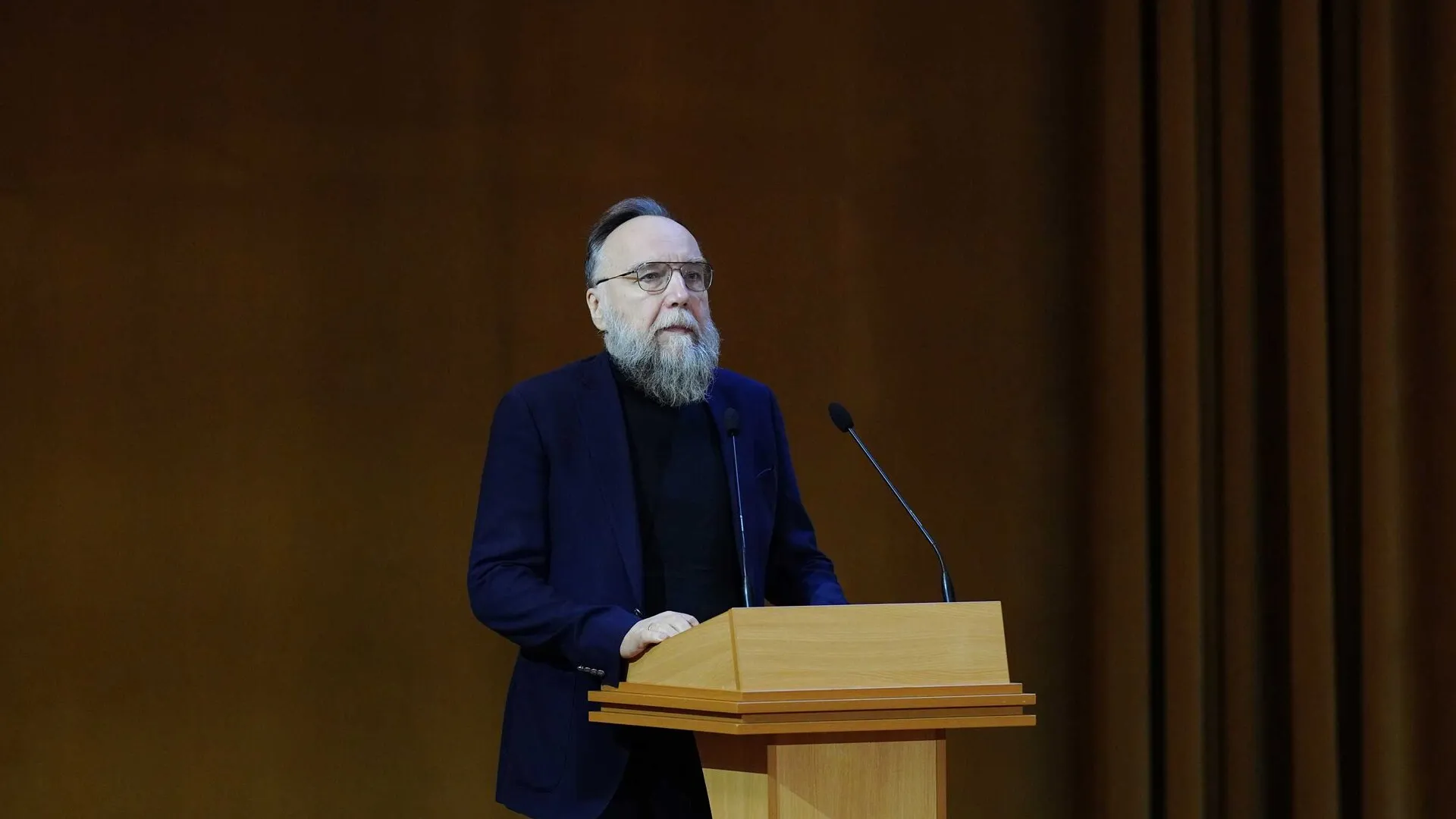
The conflict in Ukraine has put an end to the European security architecture that took shape after 1945. In trying to explain its genesis, analysts turn again and again to the figure of Alexander Dugin, decorating him with labels like “Putin’s brain” or “the Kremlin’s chief ideologue.”
Dugin is a man with an extremely peculiar biography. Expelled from the Moscow Aviation Institute, formed in the underground occultist Yuzhinsky circle and later awarded a correspondence diploma from a land-reclamation institute, he was never part of the academic elite. Nonetheless, in the late 1990s his book Foundations of Geopolitics found an audience among a disoriented Soviet officer corps. Dugin offered them a language the security services could follow: the reduction of complex world politics to an uncompromising black-and-white standoff between “tellurocracy” (the Eurasian land power) and “thalassocracy” (the maritime liberal West).
In the 2000s, when the Kremlin was looking for a formula to hold on to the post-Soviet periphery and to prevent disintegration at home, Dugin and his half-mystical “neo-Eurasianism” turned out to be in the right place at the right time. But he was never an architect of decisions. As the scholars Marlène Laruelle and Mark Galeotti have precisely observed, Dugin served not as the mind of the system but as its “emotion” — a revanchist affect, the grievance of having lost the Cold War, a phantom longing for empire.
In 2014, during the events in Crimea and the Donbas, his radical rhetoric served to mobilise the ultra-conservative flank emotionally. With the escalation of 2022, when the conflict entered a protracted ideological phase, the system called on his services once again. The death of his daughter Darya in an assassination gave his figure the halo of a “martyr,” and the Kremlin entrusted him with institutional work: in particular, running the Ivan Ilyin Educational and Research Centre at the Russian State University for the Humanities, tasked with reformatting education in the humanities.
Today Dugin promotes the narrative of “300 years in which the West corrupted Russia.” But this is precisely where the ideological emotion crosses the line of the reasonable, and the system begins to attack its own nature. The Russian Empire of the eighteenth and nineteenth centuries, headed by an essentially Germanised Holstein-Gottorp-Romanov dynasty, was built along European patterns; and the Soviet project was extracted directly from the Western philosophy of Marxism. A radical denial of the European element, served up as “authenticity,” destroys the very institutional and cultural foundations on which the state has historically rested.
An illustration of this detachment from reality came in Dugin’s much-discussed interview with Ksenia Sobchak. In it he set out his vision of the future: the demolition of the megacities, a mass exodus of the population into agrarian communes, the abandonment of financial institutions and internet rationed “by coupon.” Such eschatological utopianism looked utterly grotesque even to a conservatively minded Russian public.
Sociological data — the surveys of the Levada Center in particular — show that despite two decades of anti-Western discourse and the growing military-patriotic component of school education, Russian society, and young people above all, remains pragmatic. The West is ceasing to be perceived as a political point of reference, but it retains its status as the principal cultural and technological benchmark — the standard of quality of life the society aspires to. What has taken shape in Russia is a model of “late-Soviet doublethink”: public observance of the military rituals combined with a private demand for comfort, technology and normalisation.
The Russian state has historically developed in mobilisation spurts, in sharp and violent turns, but its elites have always retained a capacity for pragmatic, self-preserving adaptation. The system needs Dugin’s revanchism only for as long as the mobilisation project lasts. Yet radical fantasies of isolation and of a renunciation of civilisation stand in direct contradiction to the tasks of the state’s survival.
Alexander Dugin today is the chief marker of the radicalisation of power and an instrument for servicing an affect. But once the emotion is no longer needed, once the mobilisation resource exhausts itself and cold calculation and negotiation become necessary, the odious figures of the radical flank will be shifted to the periphery immediately.
Dugin’s removal from the levers of the humanities and the media will be the first intelligible signal to the entire machinery of state that the phase of ideological intoxication is over, that an internal transformation has begun, and that a new, pragmatic purpose is being sought.